
Polarization and metals
TM or TE
Section titled “TM or TE”Switch under Simulation → Polarization. The choice changes the physics, not just the colour.
TM (Ez out of plane) is the natural choice for most optics: lenses, slits, waveguides and photonic crystals of rods. The electric field is parallel to every interface in the plane, so it never builds up surface charge. Metals act as plain mirrors.
TE (Hz out of plane) puts the electric field in the plane, where it can point across a metal surface and push its electrons. That is what surface plasmons need. Use TE for anything plasmonic, and for photonic crystals made of holes rather than rods.
Switching polarization clears the fields, because the two field sets have nothing to do with each other.
Perfect conductor
Section titled “Perfect conductor”The simplest metal: the tangential electric field is held at zero inside it. It reflects everything at every wavelength and has no skin depth. Good for walls, slits and mirrors where the metal itself is not the point.
Drude metals
Section titled “Drude metals”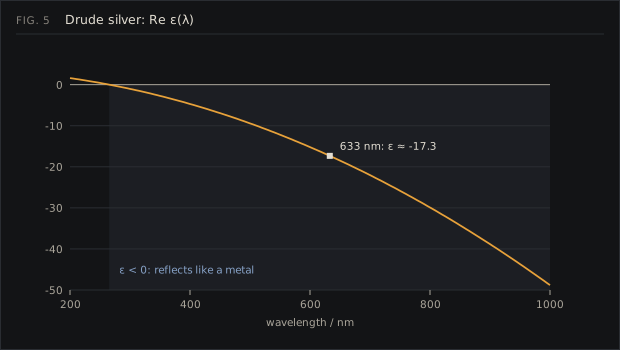
Silver and gold are modelled as free-electron metals:
ε(ω) = ε∞ − ωp² / (ω² + i γ ω)Below the plasma frequency the permittivity is negative, and the metal reflects. Light still enters a few tens of nanometres (the skin depth) and decays, and at an interface with a dielectric it can bind to the surface as a plasmon.
In the solver the free electrons carry a current J that obeys dJ/dt + γ J = ε₀ ωp² E. It is discretised with the usual auxiliary-differential-equation approach: J lives at half steps, is updated from E, and enters the E update as an extra term. Only metal cells carry J, so scenes without Drude metals pay nothing for it.
| Metal | ε∞ | λp | γ / ωp |
|---|---|---|---|
| Silver | 3.7 | 138 nm | 0.0023 |
| Gold | 9.5 | 138 nm | 0.0077 |
These are single-term fits, reasonable from about 500 nm into the near infrared. They miss the interband absorption of gold below ~550 nm, so gold looks too good a mirror in the blue. For teaching and qualitative work they are fine; for quantitative plasmonics you would want a Drude-Lorentz model, which is on the list.
The plasma frequency depends on the physical cell size, so Drude metals are the one place where the grid scale really enters the equations. If the cell gets too large (above about 60 nm) the explicit current update can become unstable. The app then stops the run and says so.