
The experiments
Every experiment is an ordinary scene: you can move its sources, redraw its geometry, save it or share it. They are sized in nanometres, so they look the same on every grid size; only the sharpness changes.
Three of them read best as intensity (press T): the lens, the parabolic mirror and the zone plate. The app switches to intensity automatically when you open them.
Basics
Section titled “Basics”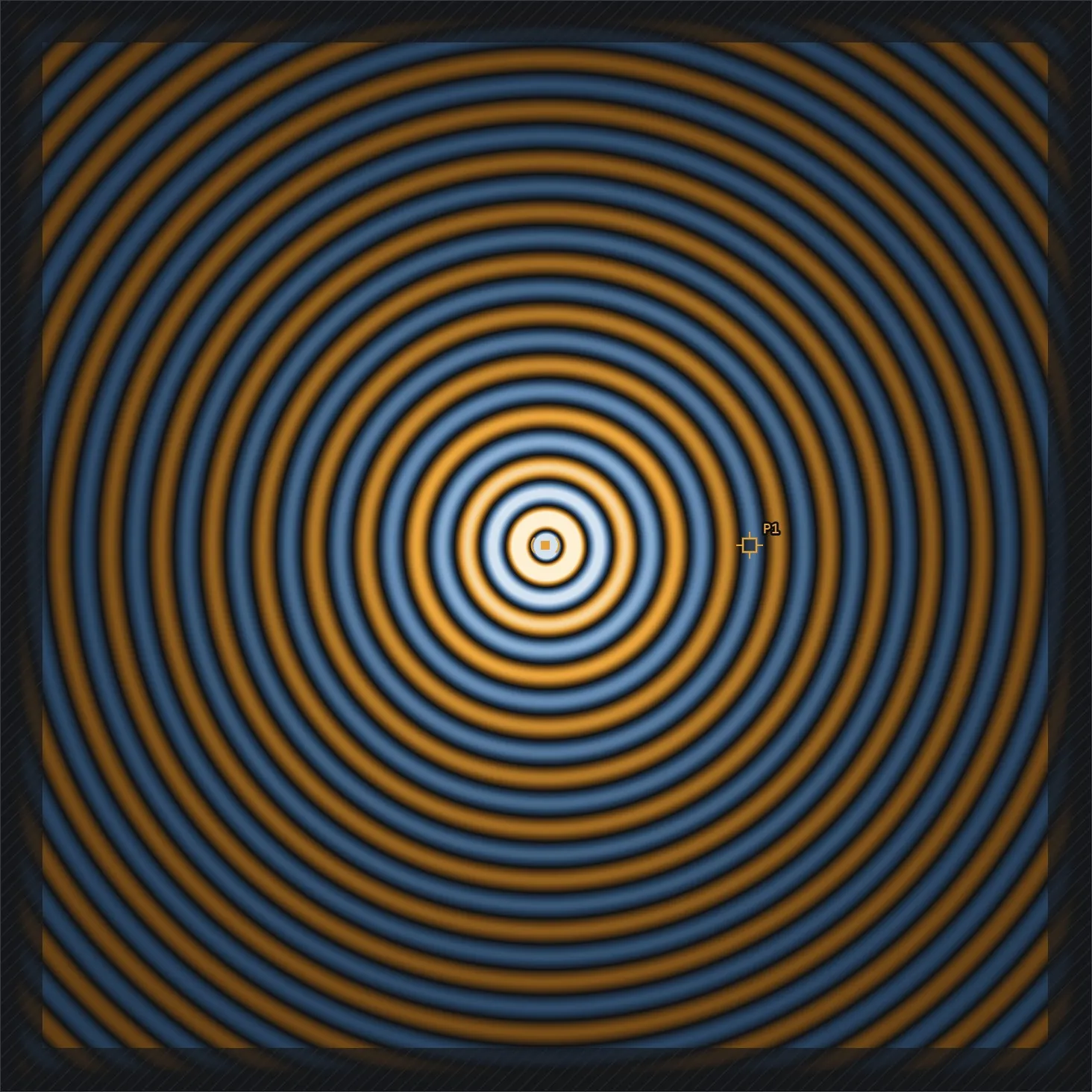
Point source. One oscillating current in empty space. The waves fade as 1/√r because this is a 2D world: the energy spreads over a circle, not a sphere. Watch the rings disappear into the hatched border instead of bouncing back; that border is the absorbing boundary described in Boundaries.
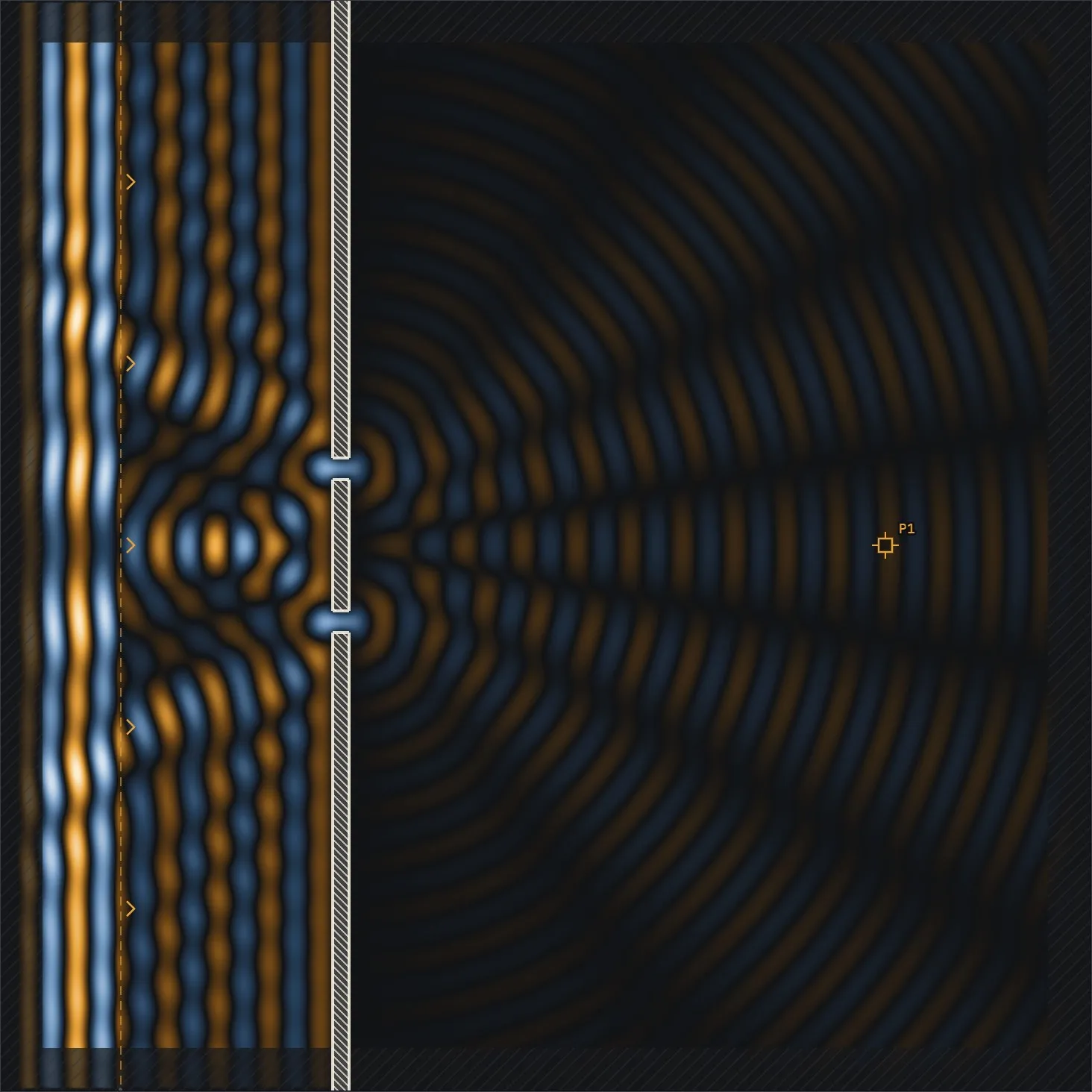
Double slit. A plane wave hits a perfectly conducting wall with two 300 nm openings. Behind the wall the two cylindrical waves interfere. The bright fringes sit where the path difference is a whole number of wavelengths. The probe on the axis sits on the central bright fringe.
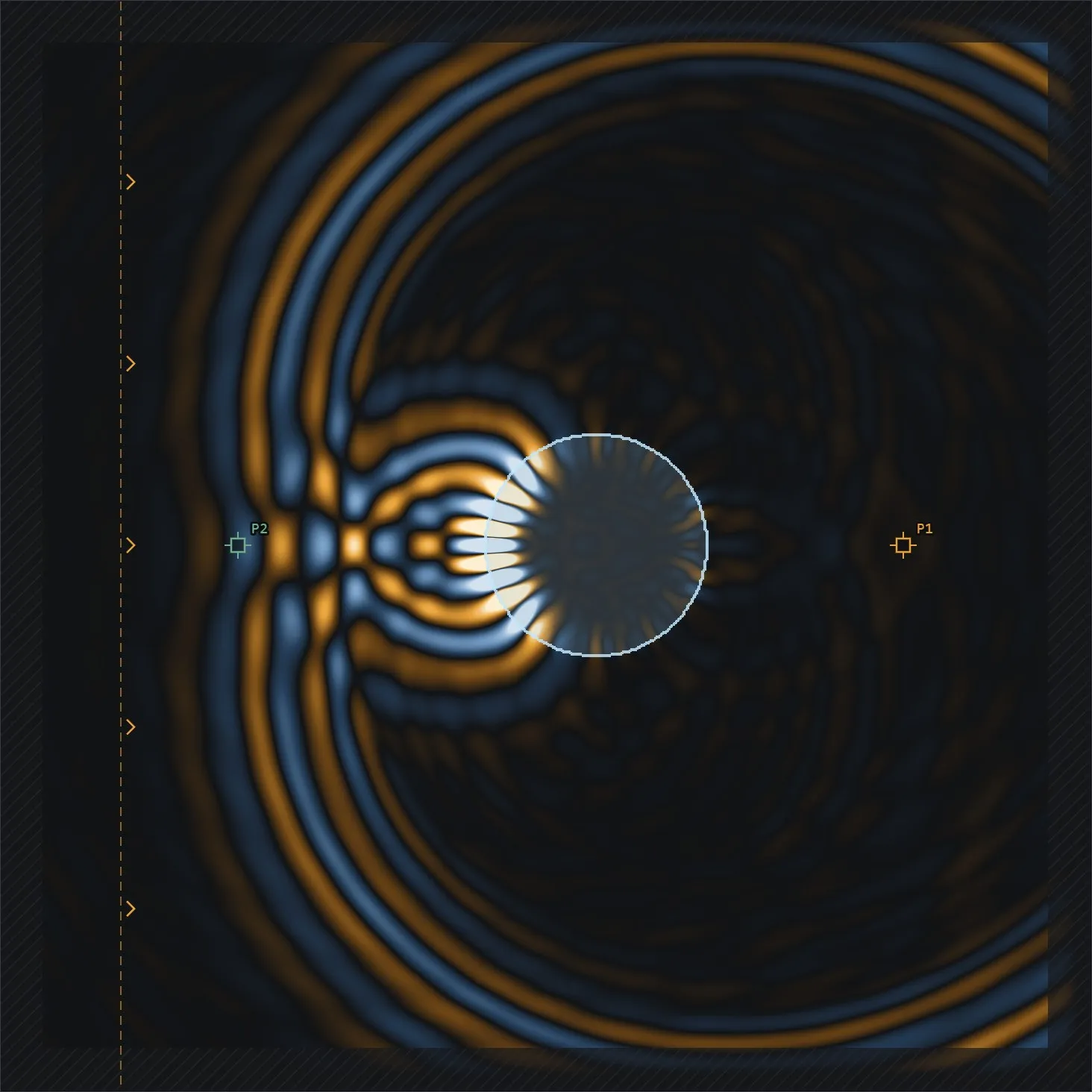
Scattering. A short pulse (not a continuous wave) crosses a glass cylinder. You see the transmitted pulse slow down inside the glass, the reflection from the front face and a train of weaker echoes from internal reflections.
Optics
Section titled “Optics”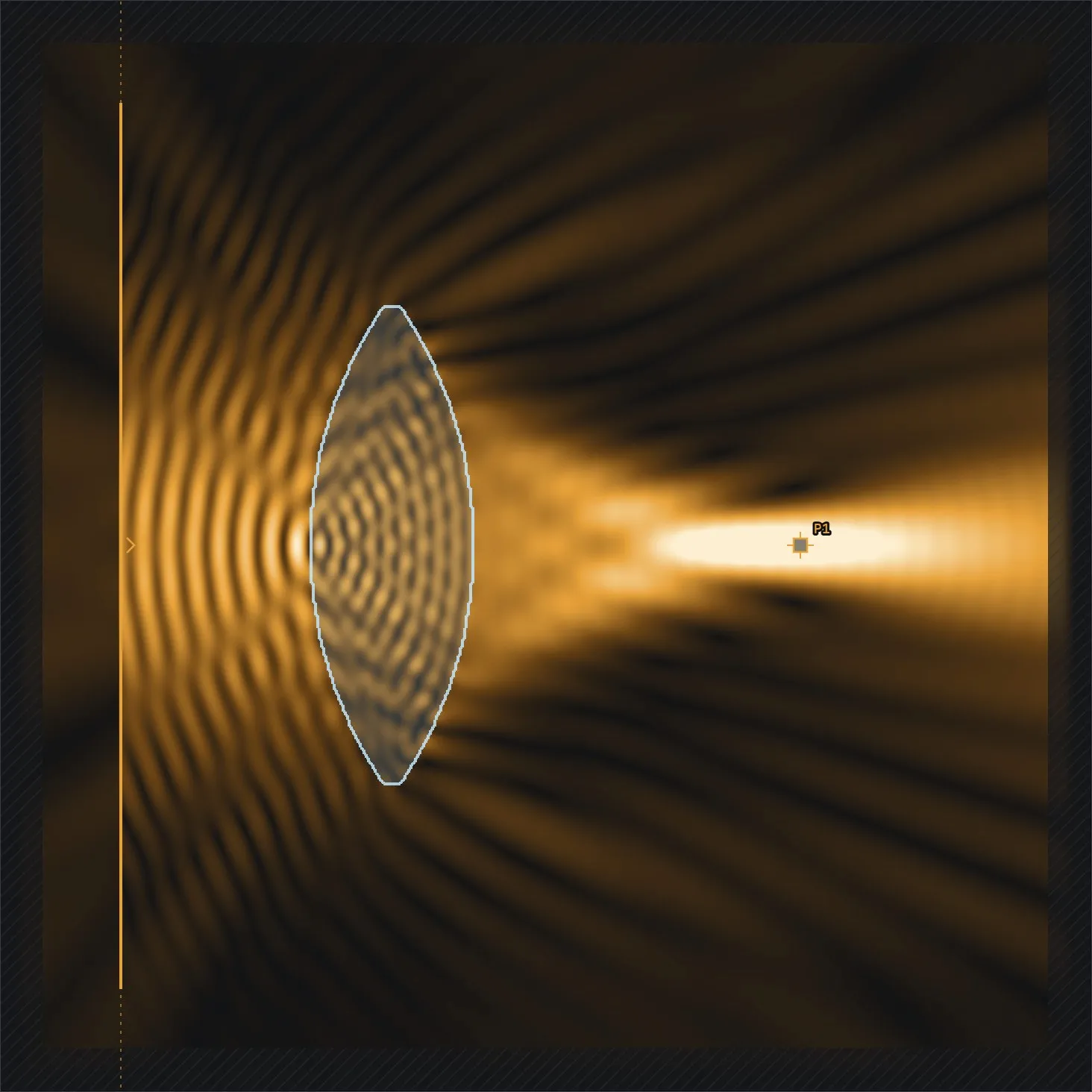
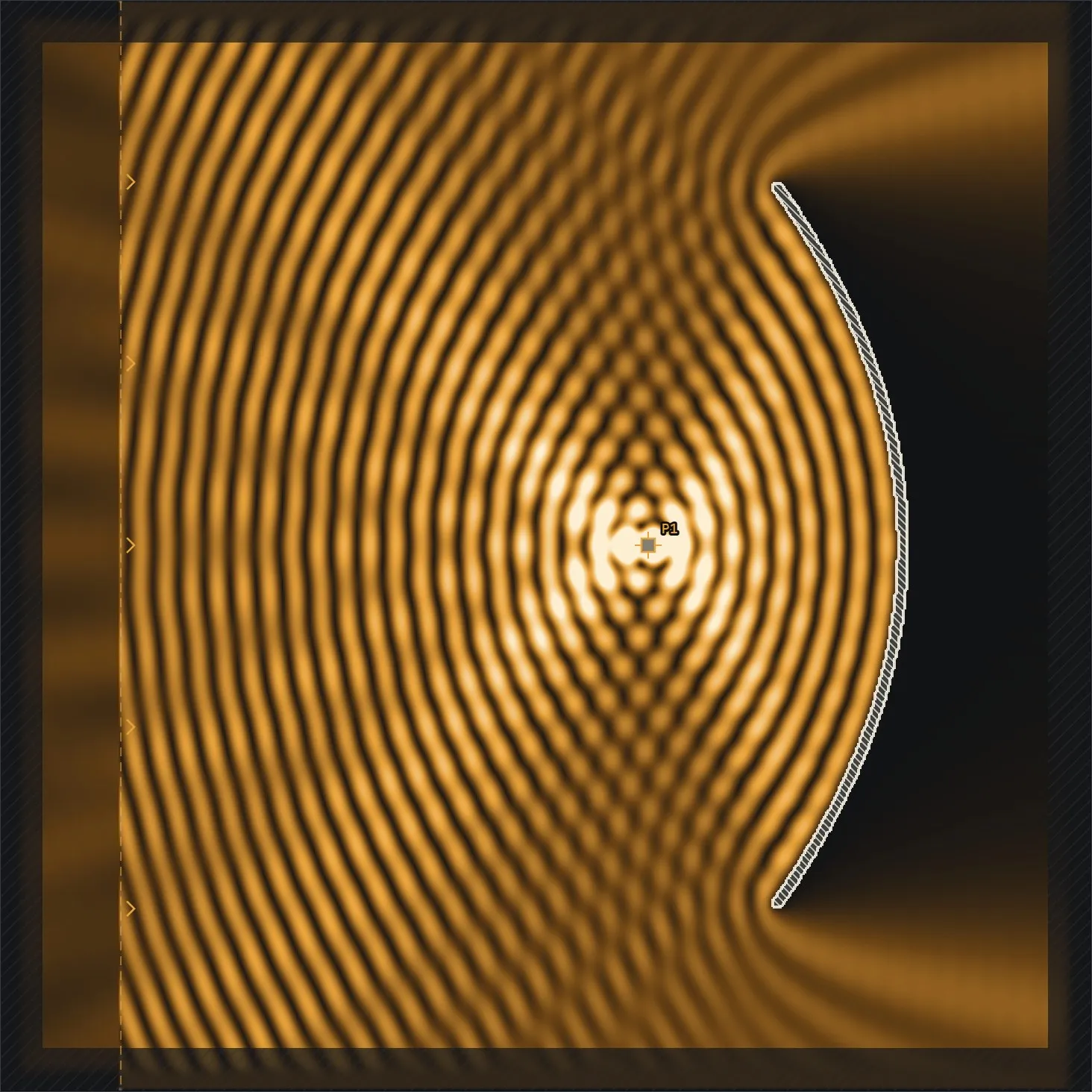
Convex lens. Both faces have a 5 µm radius, so the thin-lens focal length is R / (2(n − 1)) = 5 µm. The real focus lands a little closer because the lens is thick. Move the probe along the axis to find the brightest point.
Parabolic mirror. A metal parabola with its focus 3 µm in front of the vertex. Every ray of the incoming plane wave travels the same distance to the focus, so they all arrive in phase.
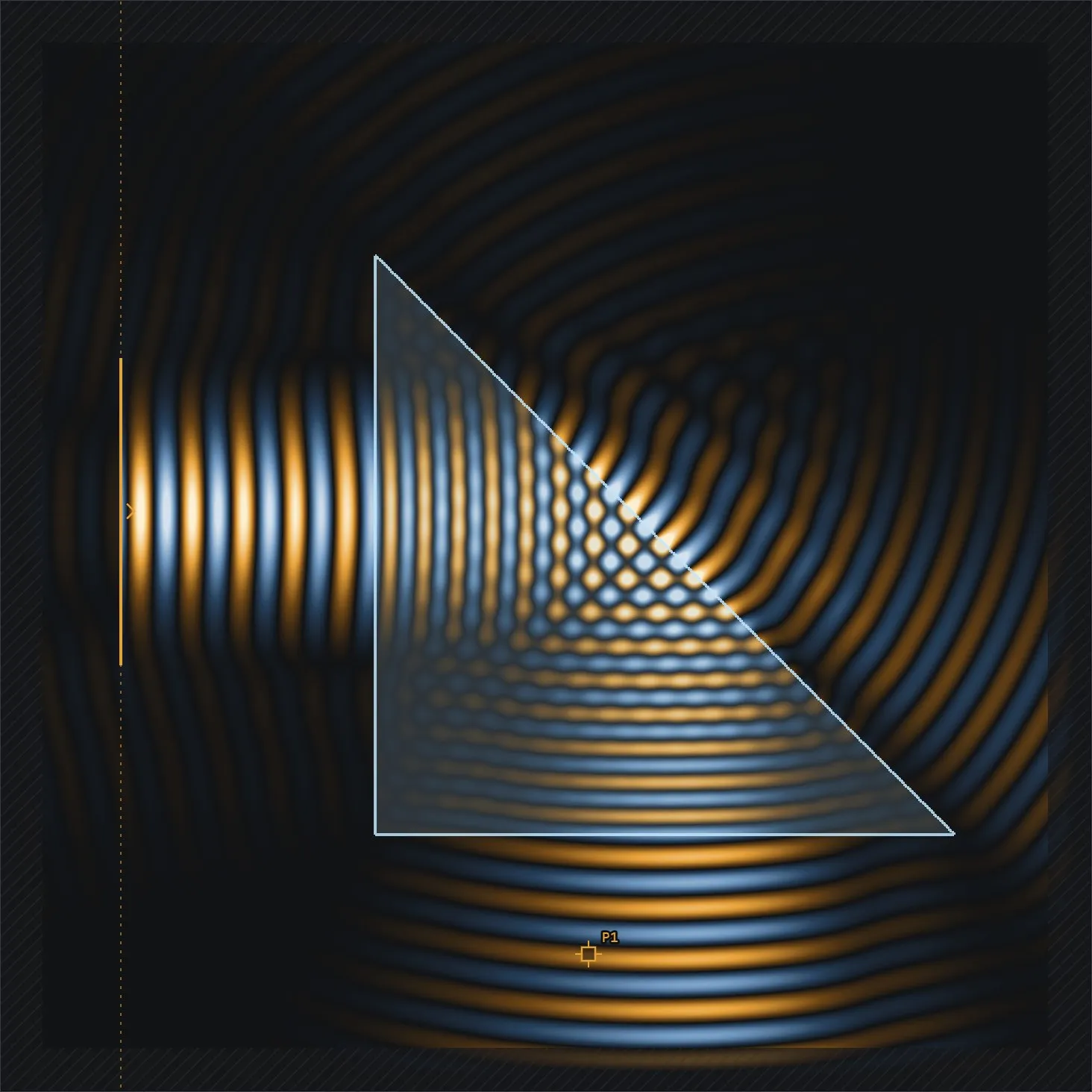
Total internal reflection. The beam meets the hypotenuse at 45°. Glass has n = 1.5, so the critical angle is arcsin(1/1.5) ≈ 41.8° and the beam is reflected completely, turning 90° downward. Change the prism material to water (n = 1.33, critical angle 48.8°) and most of the light leaks out instead.
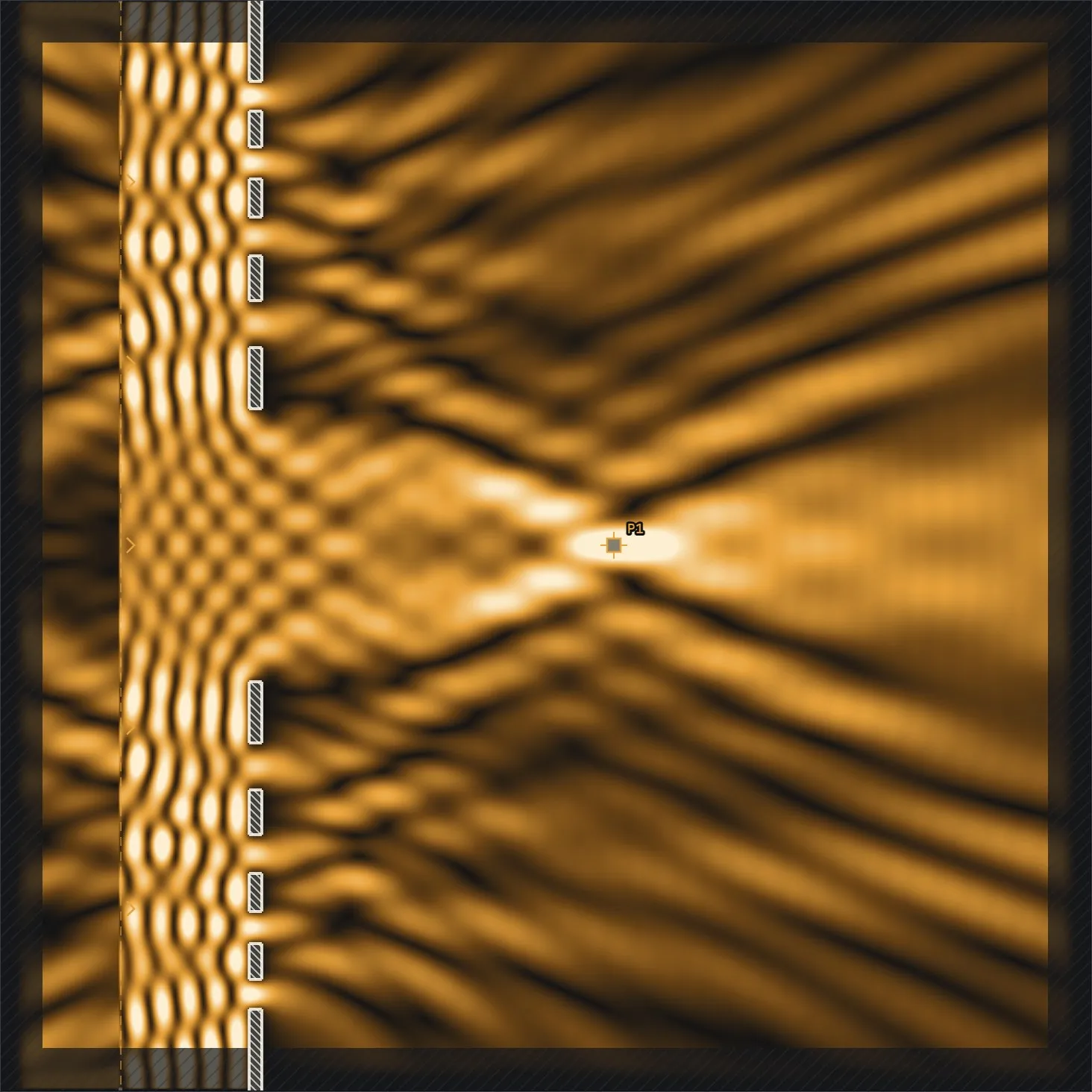
Fresnel zone plate. No glass at all: alternate rings (here, strips) are blocked so that only light arriving with a similar phase gets through. The result is a focus at the design distance of 4.2 µm.
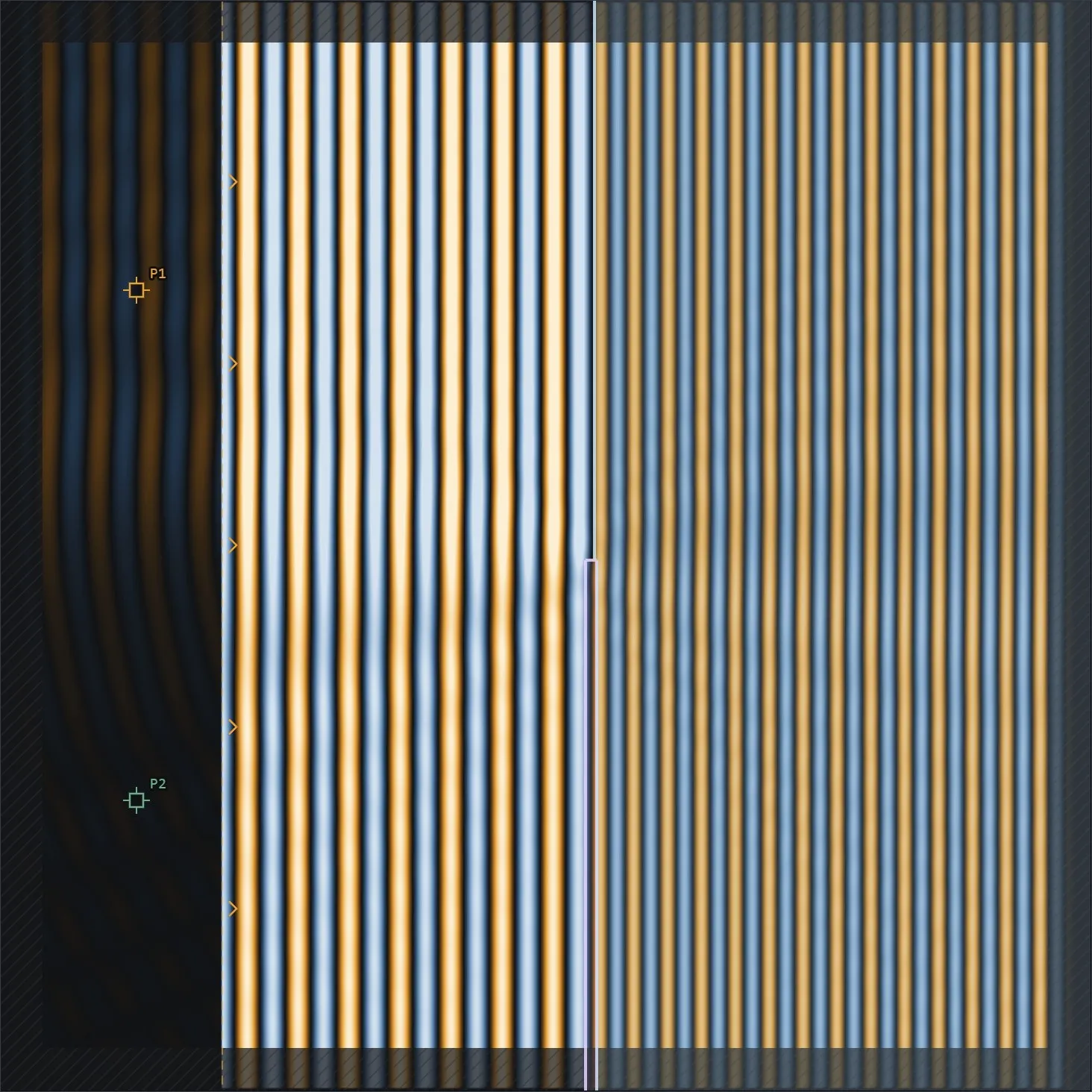
Anti-reflection coating. Bare glass reflects 4% of the light: the reflection amplitude is (n − 1)/(n + 1) = 0.2. The lower half of the block carries a layer a quarter of a wavelength thick with index √1.5. Its two reflections cancel. Both probes sit behind the source line, where only reflected light arrives. In the Signal tab the upper one (bare glass) reads about 0.2 of the incident amplitude; the lower one reads almost nothing.
Photonics
Section titled “Photonics”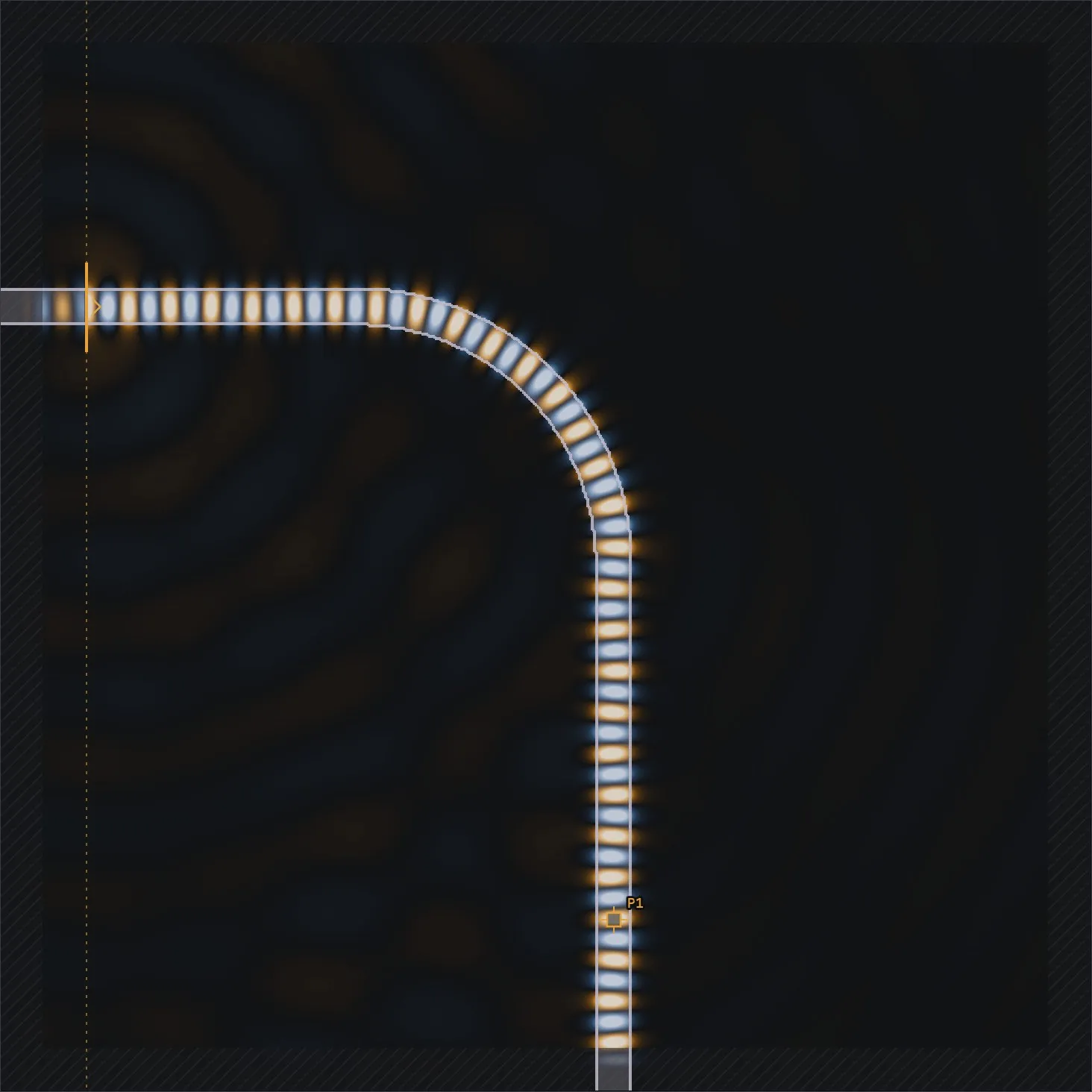
Silicon waveguide bend. Telecom light (1550 nm) in a 420 nm silicon strip. The index contrast with air is large, so the light follows a 3 µm bend with little loss. Make the bend radius smaller or the strip narrower and watch it start to radiate.
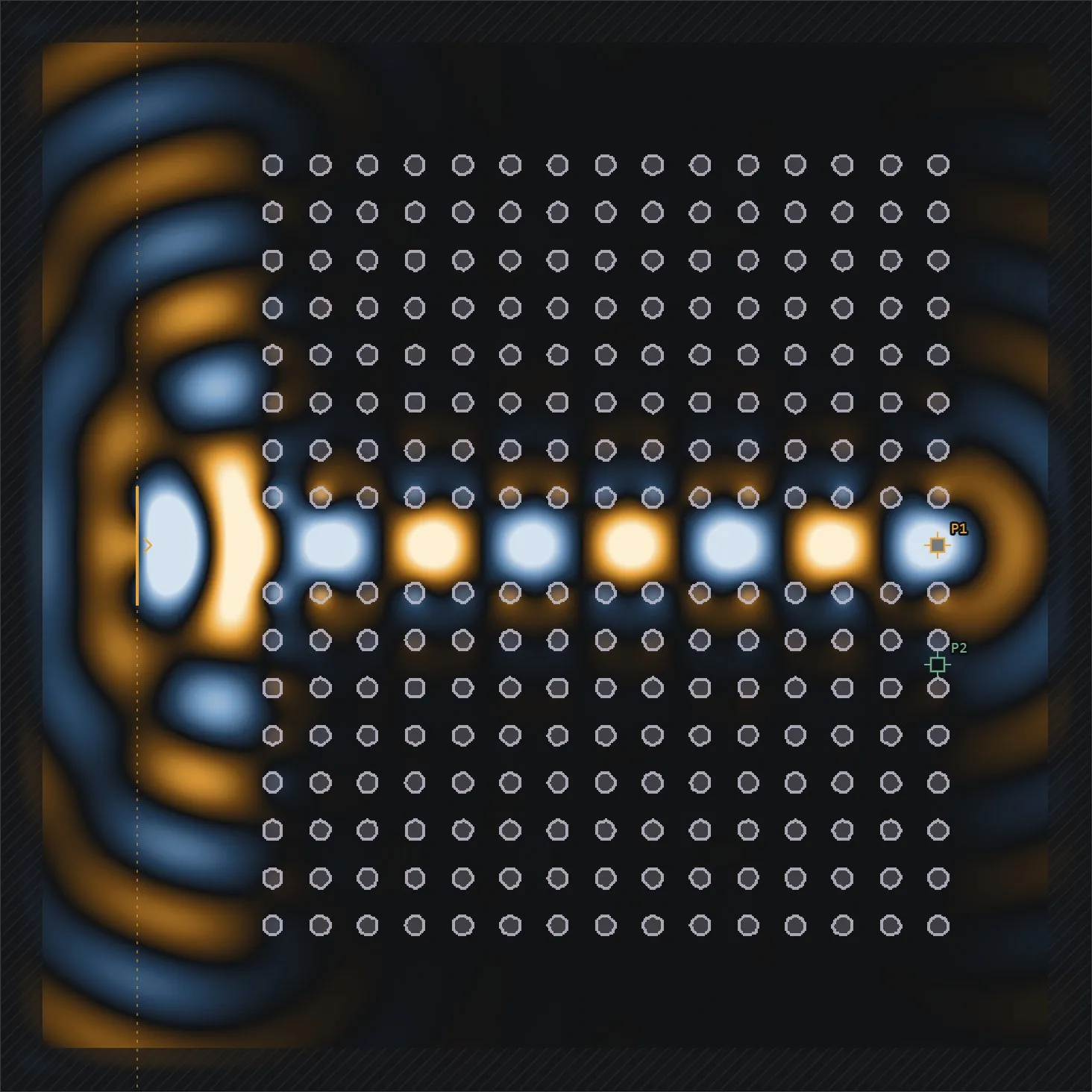
Photonic crystal. Silicon rods on a square lattice with a period of 0.36 wavelengths. At that ratio the lattice has a band gap for this polarization: light of this wavelength cannot travel through it in any direction. With one row removed, the only way through is along the missing row. Change the wavelength to 1300 nm and the confinement breaks.
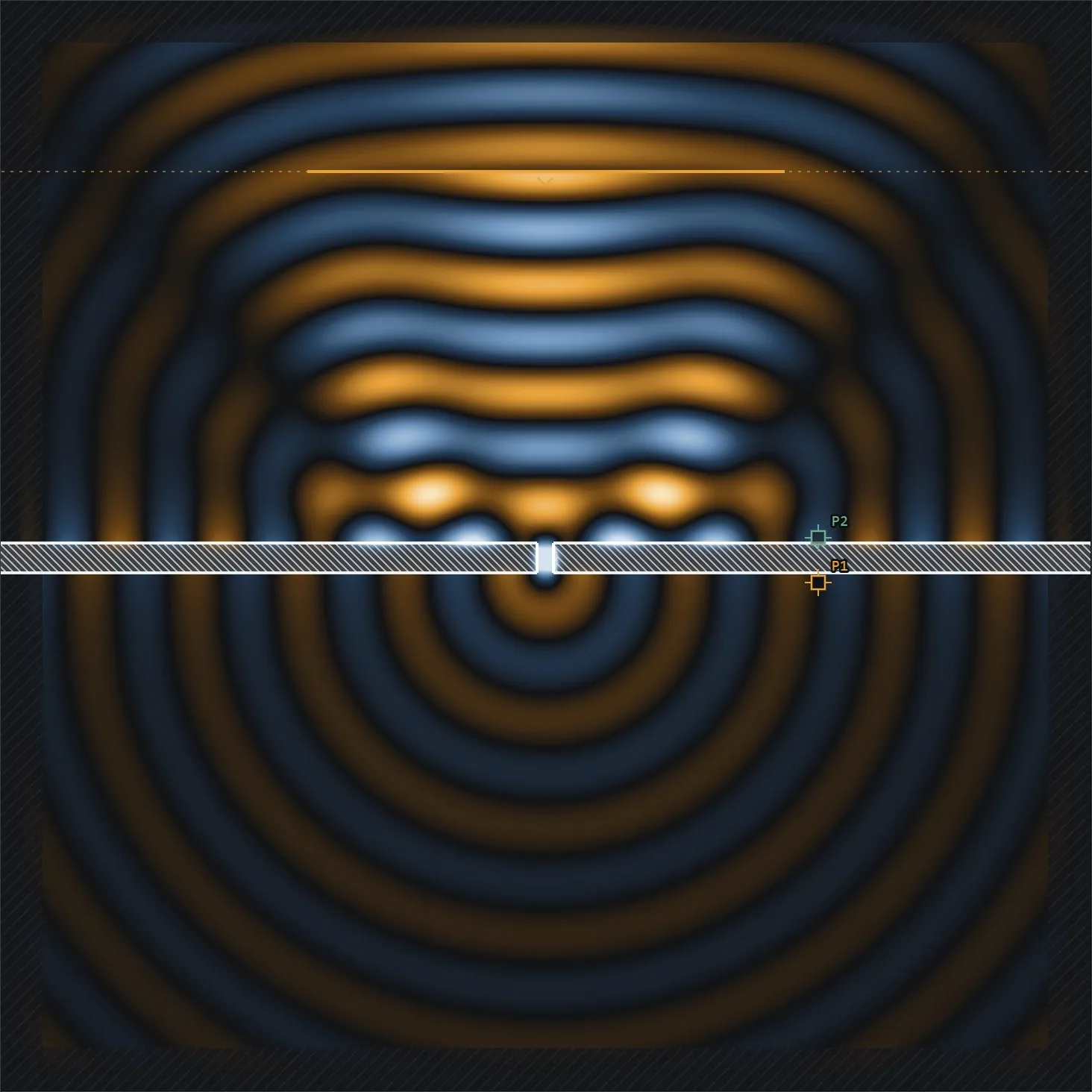
Surface plasmons. This one uses TE polarization, with the magnetic field out of the plane. Silver is modelled as a Drude metal, and light passing through a narrow slit launches waves that stay bound to the metal surface on both sides. They are shorter than the free-space wavelength and decay into the air above.
Antennas
Section titled “Antennas”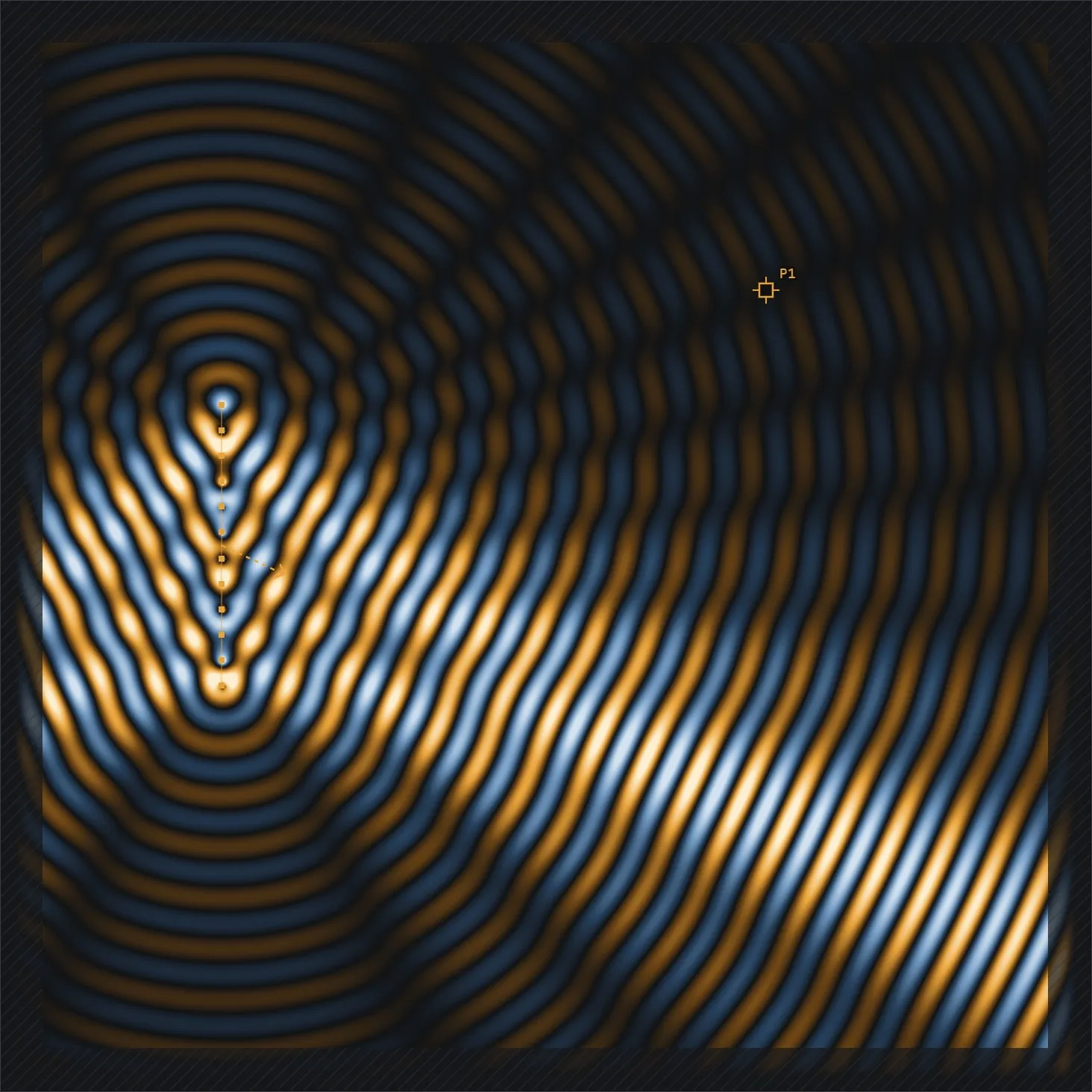
Phased array. Twelve sources half a wavelength apart, each delayed slightly more than its neighbour. The delays tilt the combined wavefront by 25°. Select the array and drag the Steering value: the beam swings without moving anything.